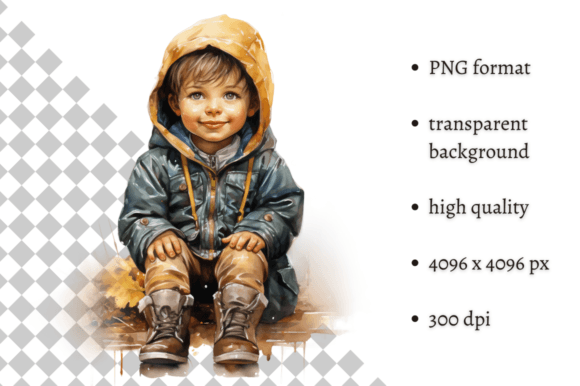
Watercolor Autumn Little Boy Clipart Review
As an embroidery designer who spends more time behind a multi-needle machine than at a computer screen, I approach digital assets with a healthy dose of skepticism. When evaluating Watercolor Autumn Little Boy Clipart for potential use in client projects or shop inventory, my first question is never about how pretty it looks on a monitor. My question is always: will this translate into stitches without becoming a dense, puckered mess? This review breaks down the practical realities of adapting this specific illustration style for machine embroidery, focusing on real-world application rather than just aesthetic appeal.
Translating Watercolor Aesthetics to Thread
The immediate charm of Watercolor Autumn Little Boy Clipart lies in its soft edges and blended color transitions. However, watercolor is inherently fluid, while embroidery is structural. When I look at this artwork, I am mentally converting paint bleeds into stitch types. For this design to work as a machine embroidery design, it likely requires a combination of techniques. Pure satin stitches often fail to capture the organic feel of watercolor illustrations. Instead, successful adaptations usually rely on complex fill stitches with varying densities or a printed fabric background combined with outline stitching.
If you are planning to use this as a traditional embroidery file where every pixel is stitched, pay close attention to the transition areas. In watercolor art, colors bleed into one another. In embroidery, abrupt color changes can create harsh lines that ruin the soft mood. I recommend checking if the digitizer has used blending techniques or gradient fills. If the design relies heavily on solid blocks of color to mimic paint, test the stitch density immediately. Overly dense fills intended to replicate opaque watercolor pigment can cause fabric distortion, especially on lighter garments.
Real-World Application: The Custom Sweatshirt Test
To truly evaluate this asset, I applied it to a scenario common for many Etsy sellers and small business owners: creating a personalized autumn sweatshirt for a toddler photo session. Fleece and French terry fabrics are popular for these items, but they present challenges for detailed illustrations. The texture of fleece can swallow fine details, making delicate facial features or small clothing accents disappear.
In this context, Watercolor Autumn Little Boy Clipart performs best when scaled appropriately. Trying to shrink this design down to a 3-inch chest logo resulted in lost definition; the watercolor effect became muddy. However, scaling it up to a 5x7 inch back print allowed the artistic intent to shine. For this sweatshirt embroidery project, using a tear-away stabilizer underneath and a light water-soluble topping was non-negotiable. The topping prevented the stitches from sinking into the fleece pile, preserving the visual clarity of the boy’s outfit and the autumn leaves surrounding him.
This size also worked beautifully as a tote bag design. Canvas tote bags offer a stable, flat surface that respects the integrity of illustrative embroidery. The natural cream color of unbleached canvas complements the warm, earthy tones typical of autumn watercolor palettes, reducing the need for excessive white underlay stitches which adds unnecessary bulk.
Navigating Fabric Limitations and Hoop Sizes
While versatile, this illustration style demands respect for fabric physics. I would advise caution when attempting baby embroidery on thin onesies or stretchy knits using this specific art style. Watercolor clipart often covers a larger surface area to maintain detail. Large stitch counts on thin, stretchy fabric are a recipe for puckering and discomfort. If you must use this for baby items, consider it as an applique design element or limit placement to non-stretch areas like yokes or collars.
Furthermore, verify your hoop size compatibility before purchasing or stitching. Illustrations of this nature often have irregular aspect ratios. A design that fits a 5x7 hoop might not fit a 4x4 hoop without significant cropping that destroys the composition. Always check the physical dimensions of the digital embroidery file against your machine’s capabilities. Do not assume resizing is safe; reducing a complex watercolor-style design by more than 10-15% can cause stitch overlap and needle breaks.
Commercial Viability and Product Value
For creative entrepreneurs, the value of Watercolor Autumn Little Boy Clipart extends beyond a single project. It serves as a strong anchor for seasonal collections. The nostalgic, hand-painted aesthetic signals "handmade" and "premium" to buyers, distinguishing your work from generic, cartoonish vector art. This perception directly impacts pricing power. Customers are often willing to pay more for custom apparel featuring unique, artistic illustrations compared to standard clipart.
However, commercial success depends on presentation. When listing finished products, use high-quality photos of the actual stitched item, not just the digital rendering. Buyers need to see how the thread interacts with the fabric. Additionally, if you sell digital assets or printable mockups, ensure your licensing allows for this specific use case. Clarify whether the license covers physical commercial embroidery sales only, or if it extends to digital redistribution. Protecting your business means understanding these boundaries clearly.
Critical Designer Notes for Success
Before committing this design to a final handmade product, run through this practical checklist derived from years of production experience:
- Test on Scrap Fabric First: Never stitch this directly onto a customer’s garment without a test run. Use a scrap of the exact same material and stabilizer combination you plan to use for the final piece.
- Check Thread Color Contrast: Watercolor designs often use subtle tonal shifts. Ensure your thread palette captures these nuances. Sometimes, using two similar shades in a split-fill technique creates better depth than a single variegated thread.
- Evaluate Small Details: Inspect facial features and extremities. If eyes or fingers are smaller than 2mm, they may not stitch out cleanly. You may need to edit the embroidery file to simplify these areas or switch to a running stitch outline.
- Stabilizer Selection is Key: For woven fabrics like denim or canvas, medium-weight cutaway provides the best long-term support for illustrative designs. For knits, always use fusible poly-mesh to prevent stretch during stitching.
- Mockup Reality Check: Create black and white mockups to assess value contrast. If the design looks flat in grayscale, it will look flat in thread, regardless of color vibrancy.
- Wash Testing: Watercolor styles can look distressed after washing if not digitized securely. Wash your test swatch to ensure the design holds up, especially for children’s wear that requires frequent laundering.
Final Verdict for Makers
Watercolor Autumn Little Boy Clipart is a delightful asset for the right maker. It excels in applications where the fabric provides stability and the scale allows for artistic expression. It is less forgiving on tiny, stretchy, or highly textured surfaces without modification. As with any design assets in our industry, success comes from understanding the translation between screen and stitch. By respecting the technical requirements of this illustration style, you can create personalized gifts and boutique products that feel genuinely crafted, elevating your brand and delighting your customers with professional-quality results.